Trading


Most of my thoughts about bottoms recently have focused more on the beach-bathing variety I’m starting to see as spring creeps back to the beach. But since everyone is wondering about the market bottom, I’ll bounce the proverbial quarter off of it and see how high it goes.

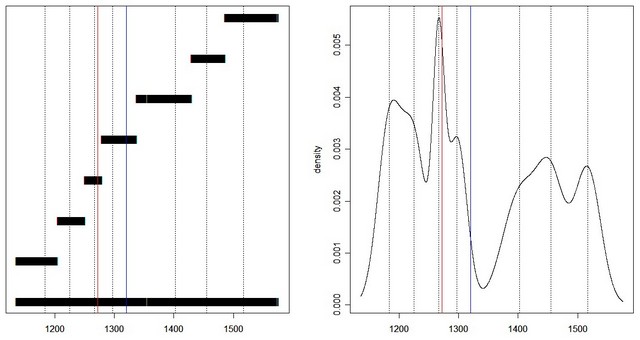
I’ve talked before about market “gravity” and price clusters that attract future bids. It’s based on basic auction theory: the price that attracts the most bidding represents the best guess at the value of an item even if people who really want the item badly (or are ill-informed or excited) will pay more (or in reverse auctions, less).

I’ve advanced my work on the idea by taking to the computer and working with the R statistical platform to analyze markets from an auction theory perspective.

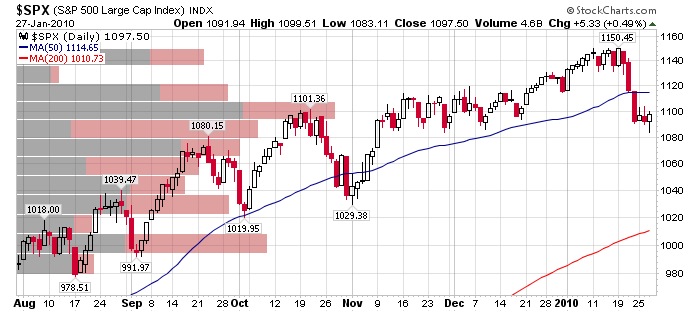
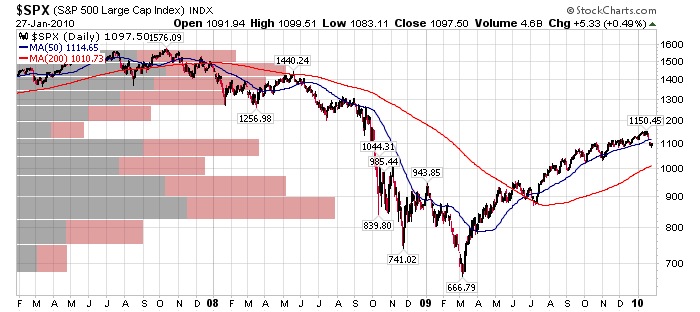
So how does the S&P look in this context? (more…)

I thought these suggestions for traders from NakedShorts was too good to not repeat here:

  • It is far more important to look to simplicity (and common sense) than it is to look to increasing complexity as a means to better control investment outcome.
  • A model whose robustness is unknown or unknowable should never be employed.
  • Sophisticated tools should only be used if it is possible to verify that all required assumptions are satisfied (at least to a good approximation).  When this condition can be met, a simple application of a sophisticated technique is preferable to a complicated one.
  • Now that Fidel Castro is stepping aside, it might be worth taking a look at the closed-end fund CUBA again. As we might expect, there was quite a pop on 2/19 when the news was announced — going from $7.50 to $9… about 20%.

    image

    As a closed-end fund, it is worth taking a look at the discount/premium to NAV:

    image

    While the chart doesn’t show it (the last data point is Jan 08), the fund is currently trading at a 9.9% premium to NAV. The impressive thing is that the fund is back down off it’s 70%+ premium at it’s highest.

    Even more telling is this 3 year chart…

    image

    As you can tell, when Fidel went into the hospital in August 06, it preceded a rather large spike in the share price of the ETF. Yes, the share price traded well over 70% above the NAV, but as a trader of the security, you have the advantage to sell at the market price regardless of the NAV. Also important, the volume spike this month was much higher than anything we saw back in 2006 or 2007.

    Would I put money on the line with CUBA right now? If I could manage the risk to my satisfaction, I would certainly consider it. There is one significant difference between the end of 2006 and today… the overall market has gone from a bullish/happy/speculative mood into a more somber/worried/panicky mood. That alone warrants caution when considering going long on pure speculations like this.

    Will Cuba (the country) benefit from Raul Castro being in control instead of Fidel? Probably not in the short term, but as we have all witnessed from time to time, markets have the ability to trade independently from the reality on the ground.

    Rumors of my demise have been greatly exaggerated. But I can say that starting a hedge fund from scratch is a petit morte of sorts. And dead mean tell no tales, right?

    Well, I’m not even sure if I should be speaking about this as the powers that be declared on high that a hedge fund can only be marketed by word-of-mouth and, even then, to “qualified investors” only. But what constitutes word-of-mouth is fuzzy. Let’s all agree that a blog is wordy and mouthy enough.

    Besides, all I’m really saying is that Lunaria Capital Management exists. And that the web site is here. (more…)

    I wanted to highlight a specific trade that I’ve been in, as well as some commentary to go along with it.

    There has been much hullabaloo in the market press lately about the subrpime fallout. We’ve seen credit markets contract, lending standards shoot up, mortgage rates climb, etc. One of the principle instruments of this trend are the CDSs (Credit Default Swaps) and similarly abbreviated CDOs, CDLs, etc.

    A while ago, I found a mutual fund that invests in the opposite side of the CDS market, and benefits if defaults or perception of default start to rise.

    It trades under the symbol AFBIX with the long name, Access Flex Bear High Yield Fund. Here is a chart of the mutual fund’s price: (more…)

    Given that the big news is the big market down day (and, as I write, the aftershock), I figured it was the perfect time to try some of the concepts I learned in Why Stock Markets Crash. Sornette provides a non-linear model formula that he attempts to fit to markets and notes that when this model finds a good fit, it often does so right before major crashes. This concept relates directly to talks of singularities. Basically, exponential growth, peppered with log-periodic (equally spaced on a log chart but closer and closer together on a standard chart) waves, results in a singularity or critical time where a crash is highly likely.

    There are several parameters that need to be optimized and, since it’s non-linear, it requires some major computation power. All those parameters make it more difficult because, during fitting, you happen upon local minima that aren’t the real best minimum. So you have to run the optimization several times with different starting seed values and hopefully converge on the answer.

    So enter Java. I wrote a program that would read in market data (S&P 500 since the ‘03 bottom) and try to perform a fit to the model. (more…)

    What the hell is my problem?

    I can’t find time to write a simple entry in this blog for 8 months while taking on a new job, getting married, going on a honeymoon and moving from the East to West coast? Gosh!

    Well, that’s about to change. [incredulous looks...] (more…)

    After yesterday’s post on the CNBC Contest Controversy, I thought I would share my experience in participating in the contest. Instead of trying to game the contest, I simply had one account and one entry in the contest.

    My highest ranking was on two different dates… if you count my highest placement versus my highest percentage rank within the pool of participants.

    • April 2 – 19,000th place, which is the top 3% - return at that point was 20%
    • May 9 – 31,203rd place, which was top 2% - return at that point was 25.87%

    My general strategy was fairly simple: (more…)

    The big news this morning is the change in tax rules for trading in China.  Officials are trying to get the recent rampant speculation under control (the SSEC is up 186% in the last 12 months) .  The Shanhai composite traded down 6.5% overnight.

    The 6.5% is barely a blip so far in the parabolic curve of the market, but this could start to shake things up…

    The big drop on Feb. 27 was preceded by a similar change in legal regulations in China, but it doesn’t look like western markets are too worried about today’s change — pre-market futures are down around 0.5% for US markets.

    Join me for a bit of silly fun in the CNBC “Million Dollar” trading contest, which starts on Monday. The prize is a “million dollars” paid in an annuity, but heck, I’ll still take it if I win.

    The basic rules:

    • You can only buy and sell stocks at the closing price of the day (market orders only)
    • No short selling, no options, no leverage
    • Mergers and share splits apply, but dividends don’t
    • Stocks must have a $500 million market cap as of their closing price on Friday March 2nd (you can use the Yahoo Stock Screener to find all 2,723 tickers that should be elligible for the contest)

    One of those crafty folks over at Fool.com has discussed the way to win the contest… He basically points out how to win any trading contest — take the biggest risks that you can and hope that you’re one of the lucky winners. A sound, safe, low risk strategy does not win contests.

    It should be very interesting to see how the first week of the contest fares if the market continues to behave like it did last week…

    Next Page »