Fri 29 Feb 2008
From Chart of the Day…
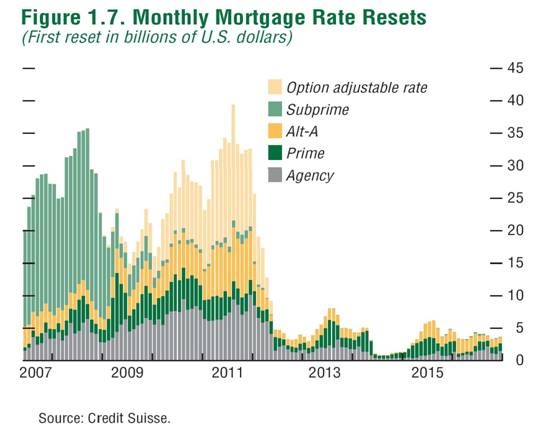
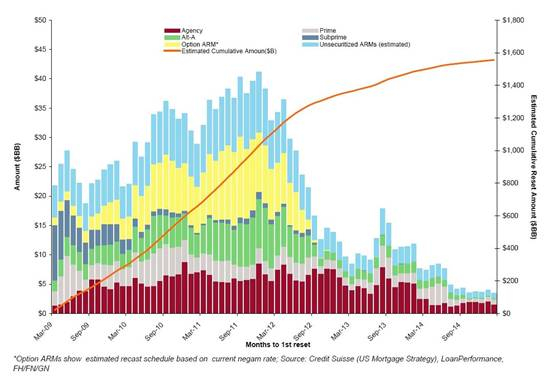
The chart pretty much speaks for itself. In case you want to feel optimistic that maybe the worst is over… It’s worth revisiting the following older chart from Credit Suisse (via Calculated Risk)…
Fri 29 Feb 2008
From Chart of the Day…
The chart pretty much speaks for itself. In case you want to feel optimistic that maybe the worst is over… It’s worth revisiting the following older chart from Credit Suisse (via Calculated Risk)…
Sun 17 Feb 2008
It’s worth taking note that the recession calculator is forecasting with a 94% probability* a recession will occur in the next 12 months. The calculation is based on the current 10 year, 3 month, and overnight rates…
It’s not surprising, considering that the yield spread (30yr/3mo) looks like this:
Wed 2 Jan 2008
It is amusing to hear all the gold bulls, and more recently the mainstream media, proclaim that the Fed is “pumping liquidity” into the system. The logical conclusion is that either the Fed is going to ruin the dollar or save the stock markets, depending on who is talking.
But John Hussman has a different take on it… all the “pumping” is simply the roll-over of short term paper lent to banks. Here is a quote from his December 17 commentary:
Last week, the Fed executed the first of its highly publicized “term auction” transactions. As I noted in A Little Acid Test for Fed “Liquidity” last week, the Fed had $53 billion in repos outstanding on Friday December 14, fully $39 billion of which were due to expire last week. This ensured that the Fed would initiate new repos of a similar amount. The acid test was whether the term auction repos would represent a) new liquidity, or b) just a different way of rolling over the same money. Last week, we learned the answer to that question is b.
This will be something to watch, as Hussman points out in Monday’s notes:
…on Friday January 4, the huge 16-day 350 billion EUR refinancing from December 19 expires. This ensures that the media will (misleadingly) report a huge apparent injection of liquidity by the ECB on Friday. The question is how huge.
…As for the Fed, a few of the short-term repos the Fed provided for holiday liquidity will expire on Thursday [Jan 3]. Until then, the extra $10 billion or so of repos in the system may put a bit of pressure on the Fed Funds rate, holding it below the target of 4.25% for a few days. The most likely day for any apparent “liquidity injection” will be that same day (Jan 3) due to the expiring repos…
Fascinating stuff, and quite interesting to peel back beneath the headlines about liquidity injection. Hussman recommends going directly to the Fed or ECB’s websites to see the data yourself; see his full articles for links and more detail on the topic.
Mon 31 Dec 2007
Back in my Econ classes, the professors laid out their version of the “proper” way to manage the Fed and the economy. Core to it was the concept of having orderly declines, rather than sharp, abrupt shocks to the system. In the 70s we had oil shocks, in 87 a single-day crash in the markets… If only (the academic argument proposed) the changes could be managed to be orderly, we would be better off as an economy.
As we can see with the current environment, this academic concept seems to have graduated to the policy makers… whether it is an orderly decline in the dollar, or stalling tactics by the Fed to let the financial stocks have an orderly decline (super-SIV anyone?), or spinning the stock markets with well-timed announcements… the Fed and the Treasury are aiming at maintaining order despite problematic situations.
The side-effect of this managed order is a lot of volatility on a short trip. The S&P 500 looks like it will finish the year with a 3.6% gain, despite having a range of over 15% throughout the year (as measured by the distance from 52 week high to 52 week low).
So, is the economy in for a recession, and by implication, is the market preparing for a bear market? I’m not sure… though the arguments are strong in either direction. I think the following quote sums up the bullish posture for me.
Week after week we’ve heard reports about the dangers to housing along with the specter of hundreds of thousands of home defaults. On top of that, we’ve read about the massive losses to the leading banks brought on by the subprime mess. We’ve been warned of a potential collapse in the entire domestic and international banking system. We’ve heard that lending by the big banks had come to a virtual halt.
In the face of all this ghastly news, the November lows in the D-J Averages have held like a rock. Increasingly, it appears, the Averages have discounted the worst that can be seen ahead. As I write, both Averages are well above their November lows.
Naturally, stock market stability despite economic turmoil is not the final arbiter in our analysis of where the markets will head from here. Market efficiency is a process after all, and the markets may still be coming to grips with economic reality.
That said, I will be watching to see which way the prices break after volume returns in the new year.
Sun 3 Dec 2006
Titled “Out-of-the-box Thoughts on the Yield Curve”, Steve Saville throws out some very good commentary on the current yield curve inversion. I have to admit that his commentary has defined my own understanding of what yield curve inversion really means and what (if anything) it forecasts. (more…)
Thu 12 Oct 2006
When working on my data for analyzing liquidity, I calculated the yield spread as TNX - IRX (10 year minus 3 month), where StockCharts provides an easy way to see TNX / IRX (10 year divided by 3 month)… and this got me thinking about my post a while ago on inflation expectations… it seems as though I may have made a minor mistake in my analysis… which leads to a major mistake in my conclusion. Mea culpa. (more…)
Fri 29 Sep 2006
When I read this AP report, my head spun. Why? That’s what happens when the media spins every number coming out of the Fed until you can’t help but get some bodypart caught in the whirlpool. This is a perfect example of what happens when monthly changes in economic releases are compared instead of looking at year-over-year. Ahead Of The Curve spends several chapters discussing the flaws of comparing one month to the next instead of looking at annual rates of change.
If you believe this article, we are all doomed. But a simple glance at y/y charts shows that income has been accelerating like a shot and that this, in turn, has now caused consumption rates to turn upwards. So the very numbers that spell doom to this writer, are actually reflective of an improving picture. Same numbers, completely opposing views. Here are the y/y charts of my two favorite economic indicators, real hourly income and real PCE (i.e. consumption):
Thu 28 Sep 2006
Mon 18 Sep 2006
I love coming across interesting charts that just make you go, “Hmm…”, like the one I posted about median income. Here is another “Hmm…” chart that seemed to fit the vibe of recent posts:
Thu 14 Sep 2006
I have to wonder whether the markets will continue to power ahead in the months ahead, or if instead that the steam is actually from a steamroller and we’re trying to pick up nickels (small profits) as it is barreling down.
[Note: the phrase "picking up nickels in front of a steamroller" is typically used to describe fixed income arbitrage, but I think it creates a nice metaphor in my current discussion.]
Let’s start with a little check in on history… (more…)